Steel and aluminum operations put conveyors under conditions that most industrial equipment never sees: heavy and uneven loads, sustained heat, mill scale and abrasive fines, and a duty cycle that assumes the line does not stop. Equipment in these plants is expected to run for decades, and it frequently does.
Transcon has built for this environment for more than 60 years. The systems are large, they are custom-engineered to the plant, and they are designed on the assumption that whatever gets installed will still be working long after the people who specified it have moved on.
Heat, Scale, and Sustained Load
Temperature. Hot material is routine in primary metals. Steel belting handles it where other belt materials simply cannot, but heat still drives design decisions well beyond belt choice: it changes belt length as the conveyor cycles between hot and cold, which is a tensioning problem, and it affects lubrication intervals on every bearing and chain component in the run.
Scale and abrasive fines. Mill scale is abrasive and it gets everywhere. It wears track and liners, works into the chain, and accumulates in the bottom of the frame. Track liner selection and access for cleanout are specified against it rather than treated as afterthoughts.
Load. Loads in these applications are heavy and often uneven, arriving in a way no averaged throughput figure captures. Belt pull, drive sizing, and frame construction are calculated against the real peak, not the nominal rate.
Sized for the Application
These are the heaviest configurations we build, and they are specified against the plant rather than against a standard.
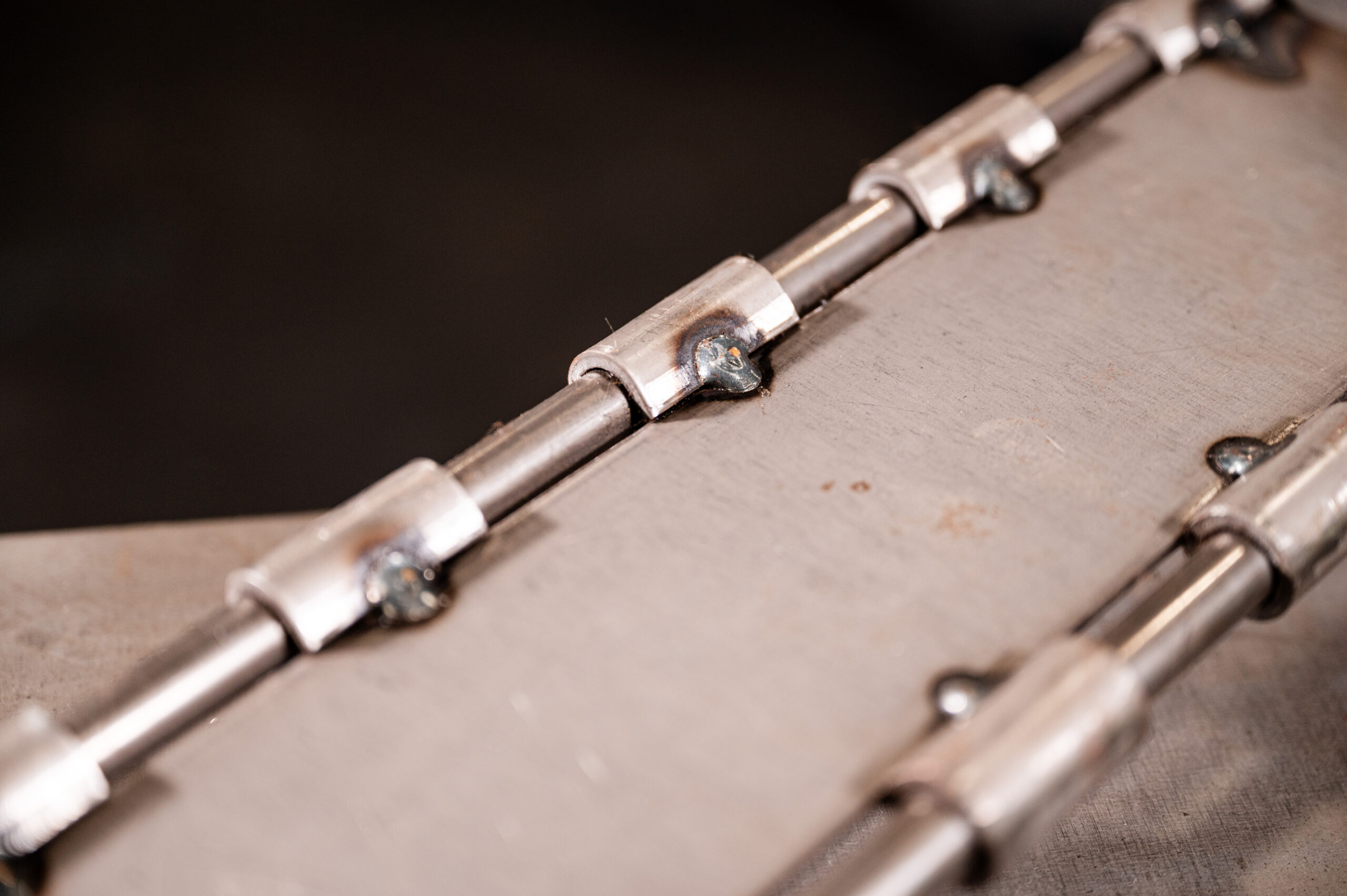
Belting
- 6″ and 9″ pitch for heavy mill duty
- Pans from 3/16″ up past 1″ thick
- Steel belting for elevated temperature service
- Cleats and side wings sized to the load and incline
- Reinforcement specified to the peak load, not the average
Frame, Drive, and Tensioning
- Heavy side panels, formed frame spreaders, heavy angle tracks
- Abrasion-resistant track liners
- Shear pin hub overload protection
- Electronic overload monitoring optional
- Spring or air take-up where thermal cycling changes belt tension
For a first-pass estimate on belt pull and horsepower from your own load, length, and incline figures, the conveyor sizing calculator will get you a working number before any conversation starts.
Thermal Cycling and Take-Up
The tensioning decision deserves particular attention in hot applications. Belting expands when it is hot and contracts when the line goes down and cools, which means tension on a manually adjusted screw take-up is only correct at one temperature. A spring or air take-up compensates continuously across that cycle and holds proper tension without anyone adjusting it, which matters because a belt that is too loose damages equipment as readily as one that is too tight. Our take-up design page covers each style and where it fits.
Rebuilds Instead of Replacements
Conveyor fundamentals have not changed much in sixty years, which is why a conveyor installed decades ago is often still the right machine for the job and simply needs new belting and worn components addressed. We build replacement belts to match an existing conveyor’s exact dimensions and load profile regardless of who originally manufactured it, including for competitors’ equipment and for machines long out of production.
In a mill environment that capability is worth more than it sounds. The conveyor is usually integrated into surrounding structure, pits, and process equipment, so a rebuild avoids the civil and integration work that dominates the cost of a replacement. If you have a machine with no nameplate data left, a serial number or a photograph is usually enough for us to start from.
Related Solutions
- Welded Hinge Steel Belt Conveyors - the core product line for mill duty
- Forging Industry Conveyors - the related high-temperature application
- Steel Belt Specifications and Options - frame and belting detail
- Custom Conveyor Systems - for large one-off engineered installations
- Parts and Service - wear components and maintenance
Common Questions
Short answers to what engineers and maintenance teams ask us most about this equipment.
Can Transcon build conveyors for high-temperature applications?
Absolutely. Our welded hinge steel belt conveyors are specifically engineered for extreme heat environments like hot forging operations, where parts can reach several thousand degrees Fahrenheit. We use heat-resistant belt materials, reinforced frames for impact zones, high-temperature bearings, rollers, and drive components, plus specialized scale-handling chutes and collection sections. These systems integrate directly with furnaces, presses, and forge hammers.
How much weight can a Transcon welded hinge belt handle?
Our welded hinge steel belt conveyors are rated for up to 600 pounds per linear foot - roughly 30 times the capacity of conventional pin-hinge conveyor belts, which typically max out around 20 lbs/ft. Combined with material up to 4 times thicker than competitors, this makes our belts ideal for severe-duty applications like hot forging, heavy scrap handling, and high-impact environments.
What conveyor solutions does Transcon offer for hot forging operations?
Our forging conveyors are built to handle extreme conditions: red-hot parts reaching several thousand degrees Fahrenheit, heavy impact from drop zones, and abrasive scale material. We use heat-resistant belt materials, reinforced frames at impact points, high-temperature bearings and drive components, and specialized scale-handling chutes and collection sections. These systems integrate directly with furnaces, presses, hammers, and trim operations to keep production moving.
Have a mill conveyor that needs to outlive the next decade?
Send the application, the load, and the environment. An engineer will work through the specification with you, whether that is a new system or new belting for a machine that is already in place.