
Nobody buys a CNC machine for its chip conveyor, and nobody thinks about the chip conveyor again until the day a nest of stringy aluminum turnings wraps a sprocket and the spindle sits idle while somebody digs it out with a hook. Chip handling is unglamorous and it is also the thing that decides whether a cell runs lights-out or needs a person babysitting it.
Transcon builds chip and turnings conveyors for machining operations, from a single machine discharge to a central system serving a full cell. Every one is specified against the chip the process actually makes, because a conveyor that handles cast iron fines beautifully can be the wrong answer for long aluminum turnings.
The Chip Decides the Conveyor
Chip form varies more than most equipment specs account for, and it is the single biggest driver of what the conveyor needs to be.
Long, stringy turnings from aluminum and softer steels are the hardest case. They tangle into nests, bridge across openings, and wrap anything rotating. They need a belt that will carry a bundle without letting it hook into the drive, and they need to be moved before they accumulate.
Short, broken chips from cast iron, brass, and properly chip-broken steel behave much better on the belt but bring the opposite problem: they are small enough to sift through gaps and fine enough to build up as sludge in the bottom of the frame.
Fines and grinding swarf are effectively a liquid with abrasive suspended in it. They will find every opening and wear whatever they move against, so containment and abrasion resistance matter more than carrying capacity.
Most real machining cells produce some mix of all three, which is why we would rather ask what you are cutting than sell you a standard unit.
Coolant Is Part of the Load
A chip conveyor in a machining application is always handling two things at once. The chip needs to leave the machine and the coolant needs to stay with the machine. Getting that split right is most of the design work.
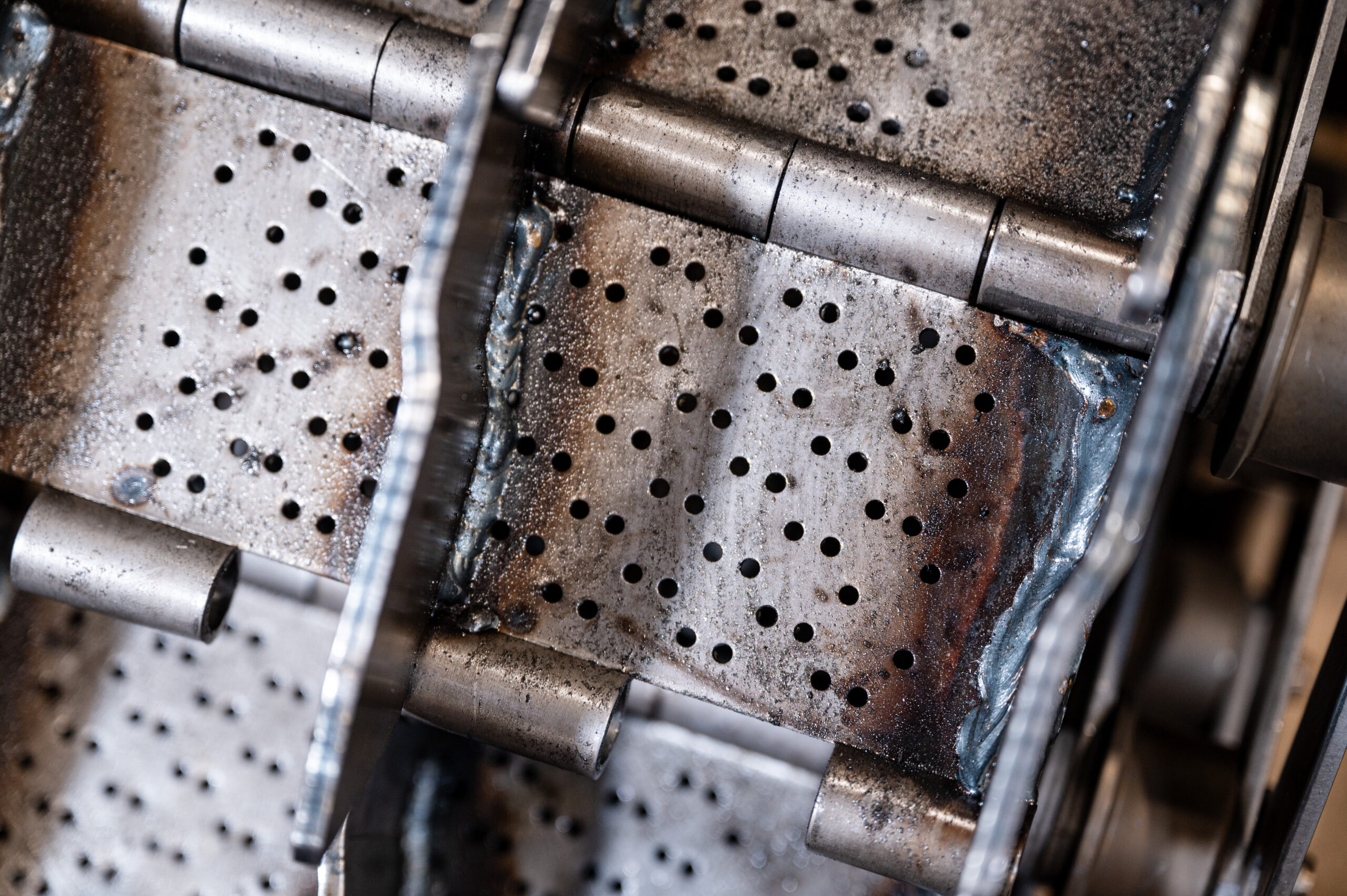
Perforated belting drains coolant back through the belt while the chip rides on. The perforation pattern is selected against chip size, because holes that drain well for cast iron fines will pass right through with a coolant that carries fine swarf, and holes that retain fines will blind over. Solid pans work where coolant carry-over is not a concern or where a separate filtration stage handles it downstream. Drag-style configurations move sludge and fines along the bottom of the trough rather than trying to carry them on a belt surface.
Configuration
Belting
- 2½″, 4″, 6″, and 9″ pitch
- 2½″ and 4″ pitch formed from 1/8″ plate
- 6″ and 9″ pitch from 3/16″ upward
- Perforated or solid pans by application
- Cleats sized to hold chips on the incline out of the machine
Layout and Drive
- Horizontal, inclined, and horizontal-to-incline runs
- Discharge height set to your chip hopper or bin
- Slip clutch on 2½″ pitch, shear pin hub on 4″ and larger
- Electronic overload monitoring optional
- Take-up style selected for maintenance access
For a working estimate of belt pull, horsepower, and drive sizing on your own numbers, use the conveyor sizing calculator.
When Chips Jam
A chip conveyor that stalls under a wrapped nest of turnings should stop itself before it damages anything. On 4″ pitch and larger we use a shear pin hub; on 2½″ pitch a slip clutch does the same job. Either way the drive gives up before the belt, sprockets, and reducer do. Electronic overload monitoring can be added on any size when the cell is unattended and you want the fault raised to the control system rather than found at shift change. The methods are covered in more detail on our overload and jamming protection page.
Rebuilds and Replacement Belting
Chip conveyors wear from the inside out, and the belt usually goes long before the frame does. We build replacement belts to match an existing conveyor’s dimensions and load profile whether or not we built the original machine, which for a machine-tool-mounted conveyor is frequently the difference between a belt order and replacing a unit that is otherwise sound.
Related Solutions
- Chip Removal Conveyors - the product page for this application
- Chip Removal Technical Overview - configurations and specifications
- Chip-Out and Part-Out Service - operation and maintenance guidance
- Parts and Service - wear items and troubleshooting
- Custom Conveyor Systems - for tight envelopes and non-standard machine interfaces
Common Questions
Short answers to what engineers and maintenance teams ask us most about this equipment.
How does Transcon handle CNC chip and turnings removal?
Our chip removal conveyor systems are specifically designed for CNC lathes, mills, machining centers, and multi-axis machines. They handle all chip types - stringy bird-nest chips from turning, coarse broken chips from milling, fine chips from drilling, and oily or coolant-laden material. Configurations include in-floor and under-machine installations, perforated belt sections for coolant drainage, and integration with filtration units. Our welded hinge design prevents chip jamming that plagues conventional belt systems.
How does a chip conveyor separate coolant from chips?
Through the belt itself. A perforated steel belt lets coolant drain back through the pan while the chip rides on top and carries to discharge.
The perforation pattern is selected for the chip you actually produce. A pattern sized for cast iron fines will blind over or pass material straight through if it is matched to the wrong chip form, so this is an application decision rather than a standard. Where coolant carry-over is not a concern, or where a separate filtration stage handles it downstream, solid pans are used instead.
For fines and grinding swarf, a drag-style configuration moves sludge along the bottom of the trough rather than trying to carry it on a belt surface. More detail on chip removal conveyor systems.
What belt options are available for handling metal chips and coolant?
For CNC machining and metalworking environments, we offer perforated belts that allow coolant to drain through while carrying chips, side wings to contain material and prevent spillover, and custom configurations to handle stringy, coarse, fine, oily, hot, or abrasive chips. Our chip removal conveyor systems can be configured for in-floor or under-machine installation and integrate with coolant filtration systems.
Tell us what you are cutting
Material, chip form, coolant, and the space you have to work with is enough for an engineer to tell you what the conveyor should be. If you already have one that keeps jamming, we can look at that instead.