
In a stamping plant the conveyor is rarely the equipment anyone thinks about, until it stops. Then it is the only equipment anyone is thinking about, because a jammed scrap conveyor under a press line will shut down every press feeding it. The dies are fine, the parts are fine, and the line is down because offal bridged in a trough that was never sized for it.
Transcon has built conveyors for metal stamping out of Mentor, Ohio for more than 60 years. Every system we build for a stamping operation is engineered around that plant’s presses, pit geometry, and scrap profile rather than pulled off a shelf and made to fit.
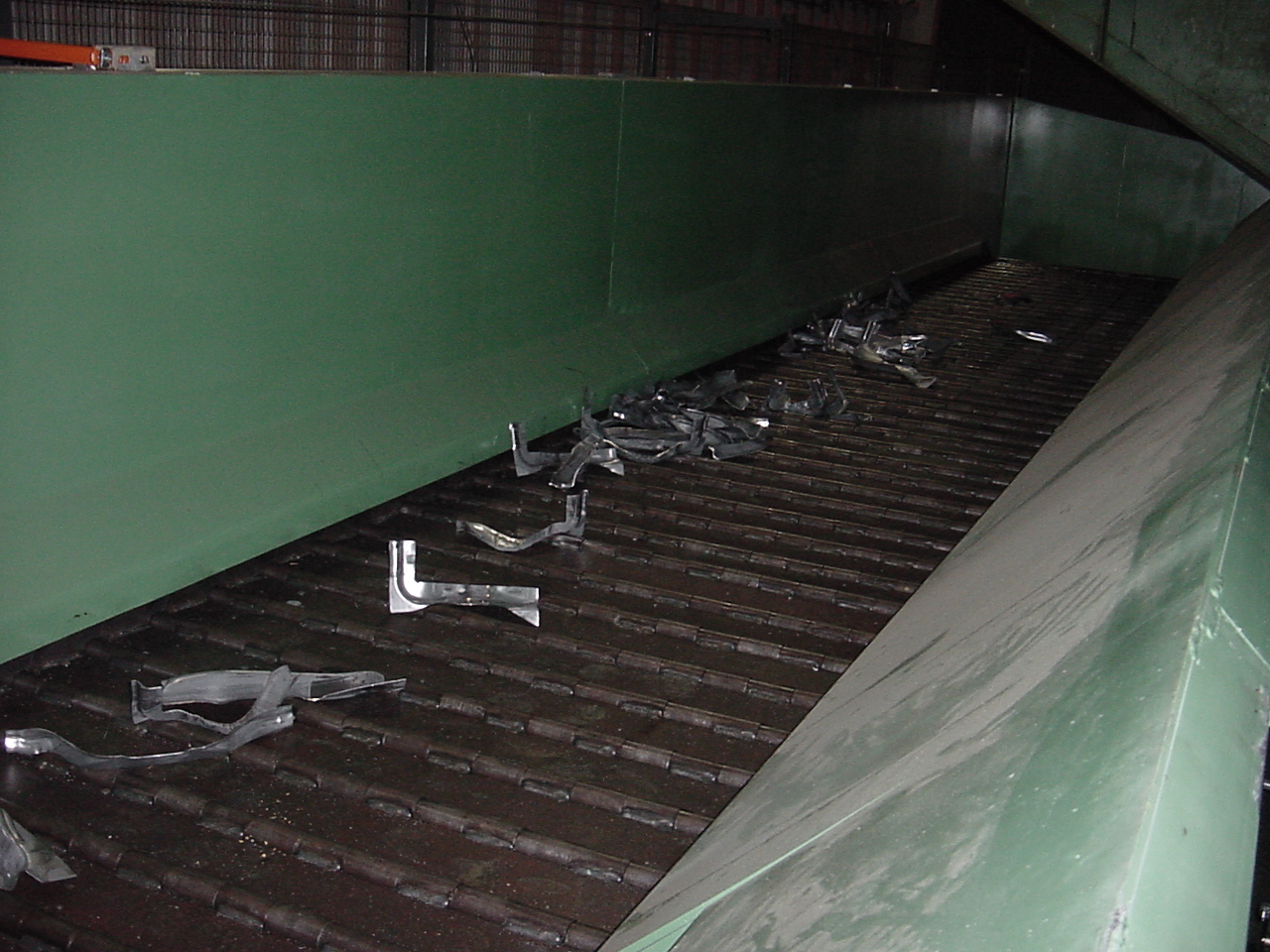
Why Stamping Scrap Breaks Ordinary Conveyors
Stamping scrap is a hostile load. Skeleton and offal come off the die with sharp edges and hooked shapes that snag on each other and bridge across a trough. Slugs and small blanks fall through anything with a gap. Draw compound and press oil coat all of it, so the load is slick and the belt is wet. Add the shock of a full hit landing at once and a conveyor built for general material handling starts failing at the belt, then the sprockets, then the drive.
That is why our stamping systems are built on welded hinge steel belt. A solid steel pan carries sharp, oily scrap without cutting, tearing, or absorbing anything, and it takes an impact load without deforming. It is also why a properly built steel belt conveyor tends to outlast the press line installed above it.
Below-Floor Systems for Multiple Press Lines
Where the plant has a pit, the most efficient layout is usually a below-floor conveyor collecting from several presses onto one line, then carrying scrap up and out to a hopper, baler, or truck. It keeps the floor clear, keeps operators away from moving scrap, and means one system handles what would otherwise be several.
These runs are engineered to the pit that already exists. We build to its real dimensions, the available headroom, the discharge height needed at the far end, and the incline angle the layout allows. Where the run has to change direction or climb, that is designed in rather than bolted on afterward.
Floor Conveyors for Individual Presses
Not every press needs to be tied into a central system, and not every plant has a pit. For standalone presses, a floor-level conveyor taking scrap from a single machine to a bin is often the better answer. It is simpler, easier to service, and it can be moved when the line gets rearranged.
The construction rules do not relax at that scale. A short conveyor under one press still sees sharp scrap, still sees oil, and still takes the full drop, so it gets the same belting and the same drive thinking as a system ten times its length.
Configured Around Your Scrap
Specifying a stamping conveyor comes down to a handful of decisions, each made against your actual operation rather than a catalog default.
Belting
- 2½″, 4″, 6″, and 9″ pitch available
- 2½″ and 4″ pitch formed from 1/8″ plate
- 6″ and 9″ pitch from 3/16″ up past 1″ thick
- Smaller pitch for fine scrap, larger pitch for bulky material and higher impact
- Cleats and side wings sized to hold the load on an incline
Drive and Protection
- Slip clutch on 2½″ pitch
- Shear pin hub on 4″, 6″, and 9″ pitch
- Electronic overload monitoring optional on any size
- Screw take-up where the conveyor ends are reachable
- Spring or air take-up where the conveyor is buried in the line
If you want to see how those decisions interact before talking to anyone, the conveyor sizing calculator gives you a working estimate from your load, length, and incline.
Keeping the Line Running
Jams are the failure mode that costs a stamping plant real money, which is why overload protection is not treated as an upsell on these systems. A shear pin or slip clutch stops the drive before the belt, sprockets, and reducer take the damage, so a jam costs a pin and ten minutes instead of a gearbox and a shift. Our page on overload and jamming protection walks through each method and when it applies.
When a system does need attention, we re-belt and rebuild conveyors regardless of who originally built them. A worn conveyor in a pit is usually a candidate for a replacement belt or a rebuild rather than a full replacement, and in a pit application that distinction matters, because the civil work is the expensive part.
Related Solutions
- Welded Hinge Steel Belt Conveyors - the product line behind most stamping installations
- Scrap Handling Systems - collection, elevation, and discharge
- Scrap Handling Technical Overview - configuration detail and specifications
- Custom Conveyor Systems - when the layout matches nothing standard
- Conveyor Take-Up Design - tensioning for hard-to-reach installations
Common Questions
Short answers to what engineers and maintenance teams ask us most about this equipment.
What scrap handling solutions are available for stamping operations?
For metal stamping operations, we offer below-ground conveyor systems that collect scrap from multiple press lines, floor-level conveyors for individual presses, under-press in-floor scrap systems, and high-capacity discharge configurations. Our conveyors handle everything from small trim scrap and skeleton material to large heavy offcuts. Enclosed or open-frame designs are available depending on your facility layout and material handling requirements.
What overload protection is available on Transcon conveyors?
Three approaches, matched to belt pitch. On 2½″ pitch conveyors we use a slip clutch. On 4″, 6″, and 9″ pitch we use a shear pin hub. Electronic overload monitoring is available as an option on any size.
All three do the same job: stop the drive before the belt, sprockets, and reducer absorb the load. A jam then costs a shear pin and a few minutes instead of a gearbox and a shift.
Electronic monitoring is worth adding where a conveyor runs unattended and you want the fault raised to the control system rather than discovered at shift change. Full detail on overload and jamming protection.
Can Transcon build conveyors for high-temperature applications?
Absolutely. Our welded hinge steel belt conveyors are specifically engineered for extreme heat environments like hot forging operations, where parts can reach several thousand degrees Fahrenheit. We use heat-resistant belt materials, reinforced frames for impact zones, high-temperature bearings, rollers, and drive components, plus specialized scale-handling chutes and collection sections. These systems integrate directly with furnaces, presses, and forge hammers.
Have a press line that keeps jamming?
Send us the layout, the scrap type, and the rate. An engineer will look at it and tell you what the system should be, including whether the conveyor you already have is worth rebuilding.