
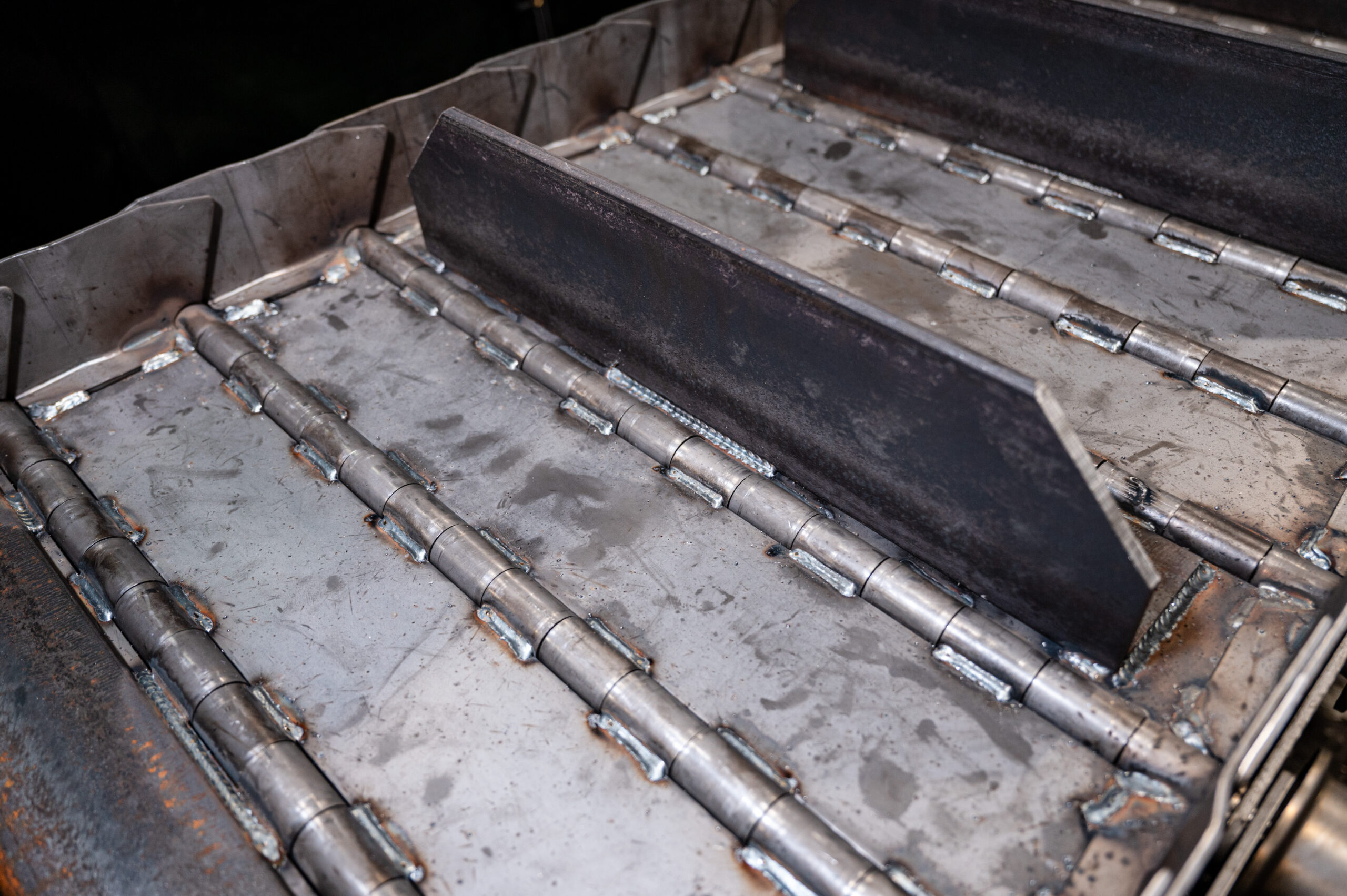
Good housekeeping and a consistent maintenance program greatly extend the service life of a Transcon steel belt conveyor. Many of our first installations are still running today - because the conveyors were built to last and maintained the right way. This guide covers safe service, the maintenance cadence, belt connection and replacement, and the parts that keep a steel belt conveyor in service.
Service Safely: Lock Out First
Before any maintenance or repair, all power to the conveyor must be tagged out and secured with a locking device. Never service, clean, or adjust the machine, and never remove a guard or cover, without first locking out all electrical controls following OSHA-compliant lock-out / tag-out procedures. All repairs should be performed by qualified personnel, and guards and safety devices must be reinstalled before the conveyor is returned to service.
Installation & Start-Up Checklist
At installation, the frame, tracks, and guides are checked for lateral and longitudinal alignment, all splice and anchor bolts and setscrews are tightened, the belt is installed in the proper direction and tensioned with the take-up, and the drive chain, reducer oil, motor rotation, shear pin or torque limiter, and all guards and safety labels are verified. The same items are rechecked during and after the first 24-hour run-in period.
Belt Connection & Replacement
Steel belting is connected and removed by working both sides of the belt together - never assemble one side and try to do the other. The sequence: remove the cotter pins or lock nuts and D-hole side bars, remove the roller block assemblies, remove the round-hole side bars, mesh the belt pan loops together, insert the connecting belt pin, then reinstall the round-hole side bars, roller block assemblies, D-hole side bars, and cotter pins. When a belt has stretched past take-up adjustment or shows worn hinge loops, it is time for belt replacement; for localized damage, belt repair may be enough.
Preventative Maintenance Schedule
The schedule below is a guide. A conveyor running in a severe environment or across multiple shifts will need more frequent attention.
Routine Checks
- Start-up: inspect for transit damage, check alignment and level, check reducer oil, take motor amperage readings
- First week: check and adjust belt tension
- First 30 days: recheck tension, full visual wear inspection
- Monthly: reducer oil, drive chain and V-belts, belt tension, loose bolts, lubrication, listen for rubbing/grinding
Periodic Service
- Semi-annually: motor amperage readings, grease pillow blocks and bearings
- Annually: remove belt, inspect frame and belting, replace worn or damaged parts, readjust
- Lubrication: mineral-oil reducers every 10,000 hours or 2 years; synthetic every 20,000 hours or 4 years - more often in hostile, wet, or dusty conditions
Troubleshooting Guide
- Conveyor with slip clutch stalls under normal load - the torque limiter may need adjustment.
- Unloaded conveyor jams, stalls, or flutters - belt tension is too loose; adjust the take-up and re-tighten the lock bolts.
- Belt hinge loops broken or bent - check for sticking or rusting, replace damaged pans, and keep the belt oiled.
- Side wings worn on the outside - look for sideward belt motion from an improperly adjusted take-up or loose belt sprockets.
- Shock current relay trips or shear pin breaks - the conveyor is loaded beyond capacity, or an obstruction is blocking belt travel. See overload and jamming protection.
- Motor runs but belt does not move - check for a broken shear pin, a slipping clutch, or a broken drive chain.
Replacement Parts
Common steel belt wear parts include the hinged belt pans and side wings, belt pins, D-hole and round-hole side bars, chain bushings and rollers, roller block assemblies, head and tail sprockets, bearings, and the shear hub or torque limiter. Always use OEM shear pins - they are designed to shear at the proper maximum load. Proper take-up setup protects all of these parts. Transcon also rebuilds conveyors - our own and most other manufacturers’ - to operate as efficiently as new.
Need parts or service for a steel belt conveyor?
Send us your conveyor serial number and what you need, and we will match the right replacement belt and parts - or schedule service. Start with a parts request.