A steel belt conveyor is only as good as the application it was built for. Move the wrong material on an off-the-shelf belt and you get downtime, premature wear, and a conveyor that fights your process instead of supporting it. Match the right belt and frame to the job, and you get trouble-free operation that protects your productivity.
That match is what Transcon engineers for. Whether you are replacing worn or damaged belting from another manufacturer, installing new belting for a process change, or designing a new conveyor system from scratch, we draw on decades of hands-on experience to build exactly what your application requires. Our welded hinge steel belt conveyors are designed to handle heavy or light loads, heavy or light impact, and unusual pressures - and to fit seamlessly into virtually any system.
Built Around Your Application
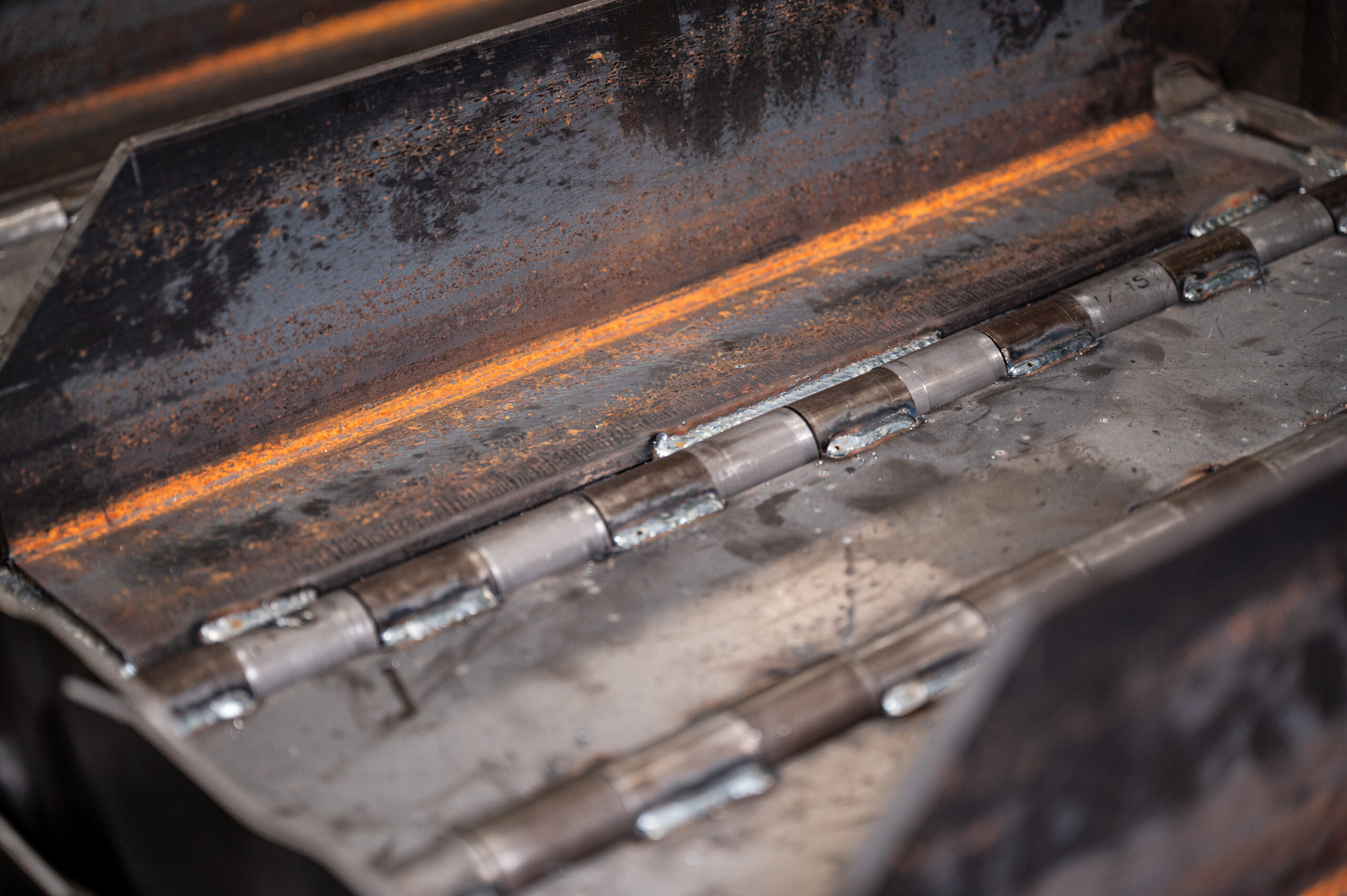
There is no single right steel belt conveyor. The right one depends on what you are moving, how hot it is, how abrasive it is, how hard it lands on the belt, and how the conveyor has to integrate with the rest of your line. Our exclusive welded hinge design lets us run longer conveyor lines and carry heavier working loads than a typical hinged steel belt. Pans are available in one piece up to 8 feet in length, or longer if required, in thicknesses from 3/16″ to 5/8″ or heavier for special applications. Available pitches are 2½″, 4″, 6″, and 9″.
Steel belt conveyors are the workhorse for scrap handling and chip and turnings removal lines, where hot, heavy, and abrasive material would chew through a lighter belt. The specifications below are starting points - almost every feature can be adjusted, reinforced, or swapped to suit the duty cycle in front of it.
2½″ & 4″ Pitch - Frame & Belting
The 2½″ and 4″ pitch conveyors cover the bulk of light- to medium-duty steel belt applications, with a closed-frame design built for durability and clean integration.
Frame Specifications
- Heavy 3/16″ thick side panels
- 3/16″ thick formed frame spreaders
- Heavy angle tracks
- Wing guide angles
- Safety bottom pans standard
Frame Options
- Abrasion-resistant track liners
- 1/8″ thick or heavier side skirting (styles applied by application)
- Loading baffles and hoppers
- Discharge chutes - manual, motorized, automatic, or bin-level sensing
- Automatic take-up arrangement - spring or air
- Automatic chain lubricator
- High-temperature application packages, controls, and special construction
Belting Specifications
- Precision die-formed steel belting
- 1/8″ thick plain surface (standard)
Belting Options
- Dimpled or perforated surface
- 3/16″ thick side wings
- Top plate and bottom side reinforcing
- Impact pads
- Welded hinge loop
- Hardened or stainless steel belt pins
- Belt cleats
- Wire mesh belts available
- High-temperature options and drag belt styles
6″ & 9″ Pitch - Heavy and Mill-Duty
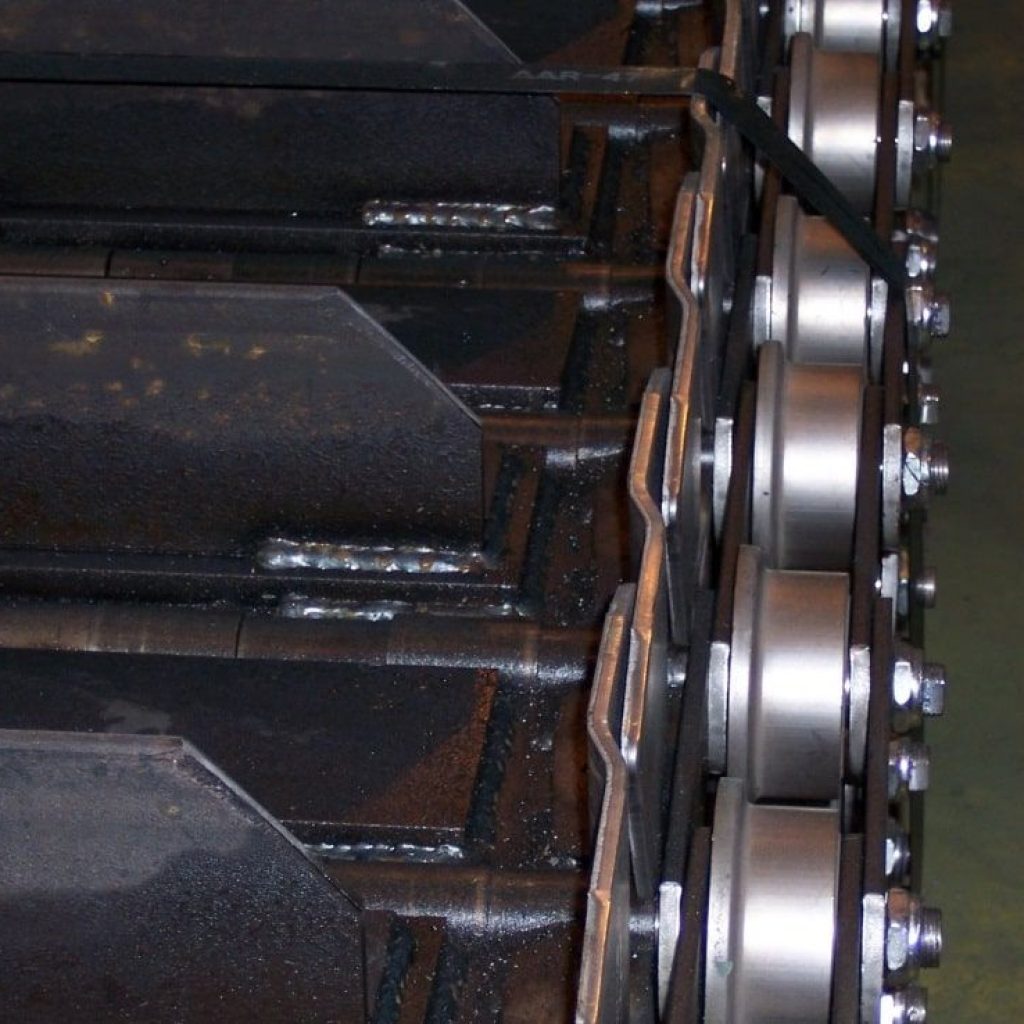
When loads, impact, and abrasion climb, the 6″ and 9″ pitch conveyors step up the construction. They are available in a standard closed frame or an open-frame truss design, and the belting moves into mill-duty thicknesses.
Frame Specifications
- Heavy 3/16″ thick side panels
- 1/4″ thick formed frame spreaders
- Heavy angle tracks and wing guide angles
- Safety bottom pans standard
Open Frame Construction Option
- Stronger truss design - light, medium, heavy, or extreme duty
- Easier maintenance access
- See-thru frame visibility
- Options: abrasion-resistant track liners, ASCE rail tracks, 3/16″ or heavier side skirting
Belting Specifications
- Precision-manufactured steel belting
- 3/16″, 1/4″, or heavy-duty 3/8″ thick plain surface
Belting & Roller Options
- Dimpled or perforated surface
- Side wings in 3/16″, 1/4″, 3/8″, and specials
- Top plate and bottom side reinforcing, impact pads
- Hardened or stainless steel belt pins, belt cleats, wire mesh belts
- “Mill-duty” and special construction
- Chain rollers: flat-face or flanged hardened sintered steel, flanged cast iron, flanged hardened solid steel, with a variety of bearing types
Configuration Options That Match the Line
Because a steel belt conveyor rarely works in isolation, the configuration matters as much as the belt. Common add-ons we engineer into a build include:
- Discharge control - manual, motorized, automatic, or bin-level-sensing discharge chutes so material lands where it needs to.
- Automatic take-up - spring or air arrangements that keep belt tension correct as conditions change.
- Automatic chain lubrication - to extend chain and roller life on continuous-duty lines.
- High-temperature packages - for hot parts, heat-treat, and quench applications.
- Loading baffles, hoppers, and abrasion-resistant liners - to protect the conveyor at the load point.
- Controls and overload protection - stand-alone or full-system, manual or automatic. See conveyor overload and jamming protection for how we guard the drivetrain.
Other Conveyor Types We Build
Decades of experience let us provide custom solutions for nearly any conveyor application. Beyond steel belt, Transcon also designs and manufactures:
- Flush top belt conveyors - heavy-duty carrying of large or bulky items through process or assembly, with side loading/unloading, fixturing, product indexing, and incline styles.
- Chain driven live roller conveyors - heavy-duty designs that accumulate product while the chain-driven roller belt keeps moving. (See powered roller conveyors.)
- Chain driven rubber belt conveyors - baler feed, shredder feed, and elevating styles for waste paper, OCC, domestic recyclables, and municipal solid waste.
- Chain driven wire mesh conveyors - washer, heat-treat quench, and hot-parts applications in carbon or stainless mesh sized to the job.
- Troughing and flat idler rubber belt conveyors - fast-moving transfer and heavier-load handling for recyclables, glass, plastics, and MSW.
- Powered roller conveyors - heavy loads with roll size and frame design set per application, including powered curves.
Explore the full range on our conveyor systems page - including industrial conveyors and chain conveyors - see conveyor belts for replacement belting, or send us a parts request to match a belt on an existing conveyor. We build for a wide range of industries, from foundries and forging to recycling and municipal solid waste.
Spec the right steel belt conveyor for your application
Tell us what you are moving and how your line runs, and our engineers will help you configure the frame, belting, and options that fit. Replacing a belt on an existing conveyor? Send us the details and we will match it.